by Bees, Desert Aid worker
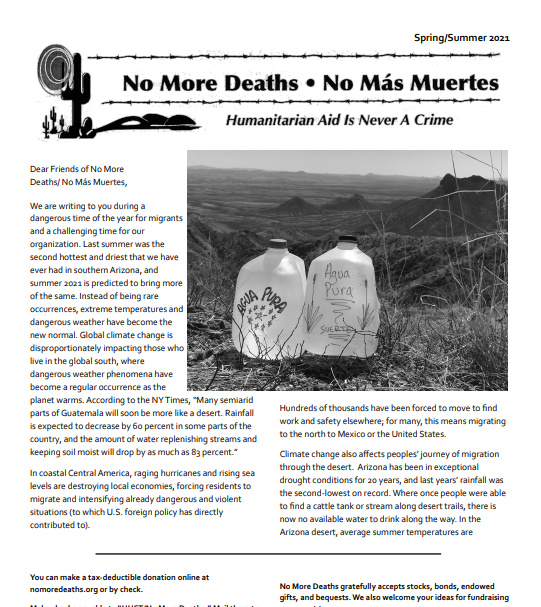
from the Winter 2022 newsletter – read it here!
I have mixed feelings about writing this piece about death in the desert.
Our organization is named No More Deaths; our stated mission is “to end death and suffering in the Mexico-US borderlands.” Death is central here, I know. But so much has already been written about the US government’s choice to use the desert as a weapon of genocide, and journalists have produced copious portraits of individual volunteers coming across deceased people at the border.
Let me first tell you, if I may, about the delight.
Let me tell you about getting my ass kicked in pick-up basketball by teenagers who had been walking through the desert for weeks. Let me tell you about how many times I’ve explained “Yes, you have correctly identified the English word for chicken, but Chicken of the Sea is not, in fact, chicken.” Let me tell you about meeting people who hadn’t had access to clean water in days and telling them (truthfully) that they smelled better than the ragtag crew of punks dropping fresh gallons and food around the Altar Valley.
Let me tell you about a man who had spent nearly a month trying to get through the Sonoran Desert on foot, whose eyes filled with tears when he spoke about the desert because to him the plants, the birds, the sunrises blossoming across the mountains, were all so wonderful. “The desert is beautiful,” he said.
In August, No More Deaths volunteers working around Arivaca found the remains of four recently deceased migrants. Death is central here, and yet none of the longer term volunteers can recall finding so many people in so short a time in this particular corridor. The desert is wonderful and terrible all at once.
Let me tell you, if I may, about the care and compassion of people in the desert.
One man explained to me why it’s difficult to report deceased people on the trails, even to humanitarian aid workers. “It’s dangerous, you know? If I tell somebody I saw a body, maybe they’ll decide I’m responsible for it. Maybe they call the police.” And then, risk be damned, that man proceeded to tell me where he saw someone who had died and made me promise that we would go look for that person. In fact, undocumented people reported three of the deceased people that we found*, ensuring that we could recover them quickly and help their families find a measure of closure.
When it would be easy to prioritize rage and anguish, I see volunteers prioritize care. People who have had traumatic experiences with law enforcement hike for miles with police to ensure a person is retrieved quickly and with dignity. Volunteers take photos of the surrounding landscape so families can see where their loved ones passed away. Atheists place flowers and pray. Cynical feelings arise in me and I wonder if these gestures are useful. Then I speak with a relative of one of the men who died.
I was in the group that found your loved one. We picked flowers and prayed for him, and for your family.
We pray for you too. Please, if you can tell me, what was it like where he died?
It was peaceful and beautiful. I know that sounds strange, but it was.
That’s good. That is helpful to hear.
Please let us know if there is anything we can do for your family.
Thank you for telling me. Thank God my cousin was found.
What the magazine profiles do not describe is that when we find people in the desert, we care for the people who walk on these trails, for their families, and for ourselves. They care for us in return, sharing food with us, sharing stories with us, asking how they can help us, and praying for us (forgiving any non-believers). Volunteers forgive each other for speaking clumsily and imprecisely, for responding from trauma and anger, for not doing and thinking everything with absolute perfection. One particularly hard day I share a feeling – that these people died close to where we leave gallons and it’s hard not to feel haunted by that – and no one shames me for it.
My fellow volunteers know the truth as well as I do. We could drop hundreds of gallons of water on every trail in the desert, and people would still die. They die because of settler colonialist violence, extraction economies, and imperialism. Because Border Patrol agents are paid to scatter and terrorize and kidnap people, instead of help them. Because horror is central to US border policy and no quantity of water can wash the blood off the hands of the people who write it. Because of a lack of care that is antithetical to so many of us in the desert.
I once met someone who carried a member of his group on his back so she could make it through alive. Another who assumed tremendous personal risk to ensure ailing people could receive urgent medical treatment. Another who reported a deceased person with the full knowledge that he might be blamed for that person’s death. I never found a way to contact the man who reported the deceased person directly to us to assure him we kept our promise, but I did run into a group who had walked the same trail. They were relieved someone cared enough to search, and then asked if we knew his name or where he was from. They intended to pray for him and his family. I told them we went to recover the body and saw that police treated the person with respect, and they asked me if I was okay.
Major publications construct a landscape of ceaseless adrenaline rushes – guides abandoning groups, cartels exacting exorbitant sums from the destitute, brutality of Border Patrol agents, death on the trails – and it feels like strange pathos porn, bordering on romanticization of the worst of humanity. What I would like to offer is that there is also care here, and I have seen the best in people.
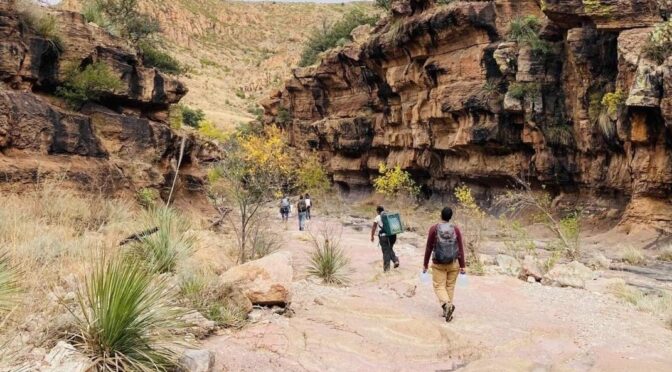
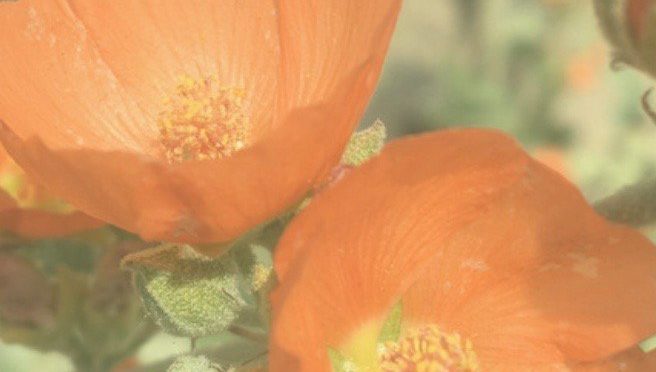
I do not ignore or erase the despair in this work, nor do I pretend away the violence. Simply: I agree with the man who told me the desert is beautiful. If you have ever lost someone close to you then you know what this feels like. Your loved one is dead, light shines through the trees, a baby giggles in your arms, the world continues to turn, and the person you loved most in the world is dead. I was present on three occasions when we found people. There were wildflowers everywhere, birds singing sweet and clear around us, creeks flowing gently in the background. We cared for the deceased, and we cared for the living.
This is what I ask us to remember when we read other stories about the border, when despair and doubt settle in to stay for a while, when the challenges feel insurmountable and endless: many awful stories are true, and so are many wonderful ones. Terrible things happen, and we can provide comfort in spite of it all.
Death is central here, and care is all around.
Author’s note: I am a white settler who grew up in the Great Lakes region, not the desert. This piece is written from that perspective, and I intend to represent no one’s experiences but my own.
*Undocumented people who witness a deceased person on the trails cannot easily report to law enforcement without facing apprehension, deportation, and other legal repercussions, as well as potential scrutiny for that person’s death. For this reason No More Death’s Missing Migrant Hotline and other search and rescue hotlines are integral to finding and recovering people quickly. For more information on how Border Patrol and other law enforcement agencies fail to recover missing people and even prevent their recovery, visit http://www.thedisappearedreport.org/.